’Hello Me’ - AI has flipped Personalisation
Marketing to a new breed of consumer wielding the power of personalisation in their favour. Not yours.
For decades, personalisation has been something brands did to consumers. AI has flipped that. Instead of brands constantly telling consumers who to become, consumers now use AI to help them figure that out for themselves.
Hello Me is a podcast from Rasmus Houlind (Agillic, Hello $Firstname) and Frans Riemersma (MartechTribe, MartechMap.com) — an open, exploratory series about what happens to marketing once consumers start using AI to define who they want to be, instead of waiting for brands to tell them.
Each episode is a genuine conversation, not a product demo or a corporate interview: 45–60 minutes, recorded remotely, with guests invited to challenge the premise rather than just confirm it. There's no fixed season, no set release schedule, and no claim to having the answers — just better questions, one conversation at a time.
Got a sharp, unusual take on personalisation, AI, or the new rules of marketing — especially if you're not already in our usual orbit? We want to hear from you.
Watch the full video playlist on YouTube: https://www.youtube.com/playlist?list=PLJGgw-cJasRw
Hello Me — the concept for the show, and every question we're chasing this season: https://omnichannelinstitute.com/hello-me.html
Hello $Firstname — a free written abstract of the book this whole show builds on: https://agillic.com/free-ebook-hello-firstname/
Hello $Firstname — the audiobook edition, with a full cast of narrators, on Spotify: https://open.spotify.com/playlist/2zIvs5pSRNTO3YAeFUWZBL?si=zpeTEW_1RnWNHSwZZEAnWA
Personalisation Cards — workshop decks for Commerce, Subscription, Banking, and Charity/NGO teams: https://omnichannelinstitute.com/cards.html
MartechTribe — Frans Riemersma's research and consultancy on marketing technology: https://www.martechtribe.com
MartechMap.com — Frans Riemersma and Scott Brinker's joint map of the global martech landscape: https://martechmap.com
Omnichannel Institute — Rasmus's home for frameworks, books, and courses on personalisation: https://www.omnichannelinstitute.com








Episodes

Oct 6, 2026
Oct 6, 2026
50 min
For years, personalisation has been us guessing what the customer wants. Scott Brinker, the "Godfather of Martech" and founder of chiefmartec.com, joins Rasmus Houlind and Frans Riemersma and closes on a different idea: instead of guessing, let the customer tell us what they want, and then deliver it.
Along the way we trace the show's origin back to a phrase Scott and Frans coined together, "agents of customers". We get into the three types of AI agents now reshaping marketing, why buyers already hold more power than most sellers have noticed, why raw software capability stopped being a moat, and what can't be prompted: trust, relationships and culture. Scott also makes the case for why a little friction in buying might be worth keeping, what happens to UI design once voice takes over, and why regional and cultural differences might be a genuine advantage rather than a weakness.
This is an open, ongoing series. We don't know exactly when the next episode drops, or who is in it. If you have a sharp, unusual take on personalisation, AI or the new rules of marketing, especially if you are not already in our usual orbit, we want to hear from you.
Chapters
0:00 - Cold open: Hello Me, AI has flipped personalisation0:30 - Introducing Scott, and a year on from Hello $Firstname3:10 - Where Hello Me started: "agents of customers"4:10 - The three types of agents, explained6:25 - The power shift: buyers, sellers and the information gap8:05 - How buyers use AI now: "call us" pricing pages and vendor-selection agents10:50 - Abundance and the empowered consumer: what do we actually want?12:30 - Are marketers still marketing to the old consumer?15:00 - Will customers notice their power? Advertising's value and its dark side17:25 - Your own agent as a filter: guardrails and filter bubbles19:10 - Where advertising goes when agents filter it out21:05 - Sycophantic AI: will your guardrails hold when you are hungry?22:40 - Is removing all friction from buying actually good?23:50 - B2B buying committees and the puppet show26:00 - Could your agent negotiate with mine?28:00 - Abundance for marketers, and a stack bigger than the landscape30:50 - The future stack: commercial products plus ambient, homegrown software31:40 - What can't be prompted: trust, relationships and the real moat33:25 - Ecosystems and culture: the moats that take time36:30 - Are organisations fit for abundance? Distinctive versus best practice38:25 - Can an AI capture culture, or feel anything?42:40 - Voice as the next interface43:55 - What happens to UI design?46:10 - Robotics, teased and parked for another day46:30 - Regional differences: US, China, EU49:10 - Closing: personalisation was guessing, so let the customer tell us50:10 - Sign-off: help us find the next guests
Sign-off and links
This is an open, ongoing series. We don't know exactly when the next episode drops, or who is in it. If you have a sharp, unusual take on personalisation, AI or the new rules of marketing, especially if you are not already in our usual orbit, tell us which of the seven questions is yours, or who we should talk to next.
Rasmus & Frans
Links and resourcesWatch the full video playlist on YouTube: https://www.youtube.com/playlist?list=PLJGgw-cJasRwThe show, the full concept and all seven questions we are chasing: https://omnichannelinstitute.com/hello-me.htmlScott's article on moats, mentioned in the episode: https://newsletter.chiefmartec.com/p/the-death-of-moats-in-marketing-and-martech-is-greatly-exaggeratedScott Brinker's chiefmartec.com: https://chiefmartec.comHello $Firstname, a free written abstract of the book this show builds on: https://agillic.com/free-ebook-hello-firstname/Hello $Firstname, the audiobook edition with a full cast of narrators, on Spotify: https://open.spotify.com/playlist/2zIvs5pSRNTO3YAeFUWZBL?si=zpeTEW_1RnWNHSwZZEAnWAPersonalisation Cards, workshop decks for Commerce, Subscription, Banking and Charity/NGO teams: https://omnichannelinstitute.com/cards.htmlMartechTribe, Frans Riemersma's research and consultancy on marketing technology: https://www.martechtribe.comMartechMap.com, Frans Riemersma and Scott Brinker's joint map of the global martech landscape: https://martechmap.comOmnichannel Institute, Rasmus's home for frameworks, books and courses on personalisation: https://www.omnichannelinstitute.com

Sep 24, 2026
Sep 24, 2026
10 min
In the chapters leading up to this point, we've explored how to create meaningful, personalised experiences across channels, campaigns, and touchpoints. We've talked about data, content, and the orchestration that brings it all together. We've introduced the Bowtie of Personalisation, the CX Layers, and the Pyramid of Personalisation to help structure that work.
But what happens when the customer never shows up?
What happens when they send an agent instead?
When this book first went to print, that question was still mostly hypothetical. It no longer is. Every major LLM now ships some form of agent mode, not just one of them. Google answers more questions directly on its results page, without a click. And, more importantly, behaviour has already started to change. Many customers no longer just browse in the traditional sense. They delegate, asking systems to search, compare, and increasingly transact on their behalf.
This is already altering the flow of traffic, the role of the website, and the point of contact between brand and consumer.
Marketers have responded to one half of that shift already: feeding structured content into the LLMs. Documentation, spec sheets, comparison pages, proof points, reviews, anything that might convince an agent, and the model behind it, that your product deserves to be the one it recommends. Keanu Taylor, reading chapter sixteen for this edition, called the discipline behind this "context engineering": deciding which content is still true, still relevant, and worth surfacing to a system that will act on it without asking you first. It's a new kind of SEO, except the reader you're optimising for has already decided not to read the page.
There's another half to this shift, on the seller's side. It's already showing up inside the marketing stack itself, as what we called elsewhere in this book the agentic platform: a layer of semi-autonomous marketing agents sitting on top of your existing systems, coordinating journeys, generating content, and triggering actions across channels. Buyer agents and seller agents are being built at the same time, on both sides of the counter, and both are being trained deliberately to deal with each other. They will get good at it. The real question isn't whether they'll negotiate well together, it's whose interests they'll have been trained to serve when they do.
For commoditised products, where the lowest price wins, this model may work well. But for emotionally anchored brands, it will challenge everything we have built around branded experience, loyalty, and long-term value.
If your flagship store is replaced by an invisible transaction between agents, where does storytelling go? Where does the moment of delight happen? What becomes of the brand?
It's possible that consumers will begin to segment their own behaviour too: relying on agents for utility-driven purchases, but still visiting brand sites when they want to be inspired, still signing up for loyalty programmes, still responding to personalisation, not just of price, but of message, tone, and experience.
And it's possible that some will train and deploy agents that reflect their own values: agents that aren't financed by advertising, that factor in long-term preferences and who the person wants to become, not just what they want to buy.
That's the hopeful version. Here's the complication. Matthew Niederberger, who read chapter twenty for this edition, pointed out that if an agent is going to remember what a customer told it and act on that next time, the memory has to live somewhere, and somebody has to govern it. Most organisations haven't worked out who that somebody is yet. But there's a bigger version of the same problem sitting one level up. When your customer sends an agent, they tend to assume it's working for them: their preferences, their history, their taste. In practice, that profile mostly doesn't live with the customer, and it doesn't live with you either. It lives with whichever company built the model doing the delegating, OpenAI, Anthropic, Google, and a short list of others. The consumer believes they own their own preferences. The brand hopes it owns the relationship. The platform, in the meantime, quietly owns the only complete copy of both.
So what's actually changed since these pages were first written? Not quite what you'd expect. Steen Rasmussen, who read chapter seventeen for this edition, put a useful correction on it: agentic commerce hasn't suddenly made personalisation hyper-individual overnight. What's actually moved is the cost of execution, and it's dropped fast, for you and for every one of your competitors at the same time. That's a Red Queen effect. You're not running to get ahead any more, you're running to stay where you already are. Once execution is cheap for everyone, doing more of it stops being an edge and becomes table stakes. The bar didn't move because personalisation got smarter. It moved because the whole field started running at once.
So if execution isn't where the advantage lives any more, where does it live? Scott Brinker answered that sharply in his Chief Martec newsletter this month. The things that still differentiate a brand, he argued, are the ones you can't produce with a prompt. He calls them the Big E's: Experience and Ecosystem. An experience your customers have loved, and had again, and again, until it becomes something they trust and expect rather than something you generated in a batch. An ecosystem: the retailers, partners, communities, and customers who choose to keep showing up for you, earned one relationship at a time, over years a competitor can't compress by throwing more agents at the problem. It's the same point Matt Johnson made, reading chapter four, from the other direction: once everyone can hyper-personalise, the differentiator stops being how much you personalise, and becomes how, and how much of your own brand's personality survives the process. A competitor can copy your interface with a prompt. They can't prompt their way into your reputation, or into someone else's community, or into the years it took you to earn either.
And behind every agent, still, is a person. Someone who forms emotional connections, decides whether to trust you, and remembers how you made them feel. Kim Motroen, reading chapter one, put it simply: personalisation was never really about how advanced your technology is, it's about how well you turn it into something a customer actually feels the benefit of. Peter Anders Franch, from Matas, reading chapter nine, made the same point from the other side of the till: AI gets you to relevance faster and at greater scale than before, but the judgement, the empathy, the read of what this person needs in this moment, still has to come from a person. That was true before agents existed. It may be truer now, precisely because everything around it just got cheaper and faster.
The frameworks in this book still apply. They just extend into a new layer: personalisation is no longer only about orchestrating communication with people, but also about orchestrating the interfaces and the memory of the systems people trust to act on their behalf, and about building the kind of experience and reputation no agent can shortcut its way into.
None of this stays still long enough to fit neatly inside a book, generative AI edition or not. That's actually why, not long after finishing this manuscript, I sat down with Frans Riemersma and started a podcast instead. It's called Hello Me, and the premise is the mirror image of everything above. For years, brands personalised for consumers. Now consumers have the power to use personalisation as a tool for becoming a better version of themselves, not just a better-targeted customer. AI is quietly taking away the excuse of never having had the means to do that. If they realise it. As the show's own tagline puts it, we're "marketing to a new breed of consumer wielding the power of personalisation in their favour. Not yours." If you want to keep following this conversation past the last page of this book, that's where I'm having it, one open question at a time.
The customer journey is not over. But it may now begin with:
'Hey, agent, get me something good.'
More resources from the Hello $Firstname universe
You can buy the physical book here: https://amzn.eu/d/6jV4QZT
If the Amazon EU link does not work in your country, please search for Hello $Firstname: Profiting from Personalisation, AI Edition on your local Amazon store.
You can download the illustrations and models from the book here: https://www.omnichannelinstitute.com/en/resources
You can also learn more about the Personalisation Cards and Canvas, which help teams turn the Bowtie of Personalisation into practical use cases, here: https://www.omnichannelinstitute.com/en/personalizationcards
Sep 23, 2026
Sep 23, 2026
9 min
In Chapter 22 of Hello $Firstname, Arild Horsberg reads ‘Achieving Organisational Maturity for Personalisation’.
Arild Horsberg is general manager of Forte Optimize in Oslo, Norway. In this chapter, he reads the final chapter of Part Four, where the book brings people and skills, technology, and governance together and turns the maturity model into action.
Knowing the levels of the back end of the Pyramid of Personalisation does not by itself help you move from one level to the next. This short chapter focuses on the actions needed to break through the otherwise invisible glass ceilings between Hack, Pack, and Stack.
To break through from Hack to Pack, the chapter recommends stabilising the performance of your core platforms, moving from a simple email service provider to a real marketing automation or customer engagement platform, and establishing clarity around how the data layer should work. It also recommends establishing a brand LLM, transitioning your team of builders into a team of executors, and documenting both your existing and your future marketing processes. As the chapter puts it, building the car and driving it are two different jobs.
To break through from Pack to Stack, the chapter recommends deploying complementary personalisation technologies, streamlining the content and data layers, and establishing agile, cross-functional journey teams with agentic support. Finally, it calls for realigning incentives and personalisation accountability around customer centricity, because if you keep measuring the old metrics, you will not get the new results you are after.
In his reflection at the end, Arild agrees wholeheartedly and adds one piece of advice: do not let IT have the decisive role in this process. It must be owned by the people responsible for customer communication and the customer journey. And make sure that person has enough empowerment not only to say no to ideas, but to say yes, this is how we are going to do it.
More resources from the Hello $Firstname universe
You can buy the physical book here: https://amzn.eu/d/6jV4QZT
If the Amazon EU link does not work in your country, please search for Hello $Firstname: Profiting from Personalisation, AI Edition on your local Amazon store.
You can download the illustrations and models from the book here: https://www.omnichannelinstitute.com/en/resources
You can also learn more about the Personalisation Cards and Canvas, which help teams turn the Bowtie of Personalisation into practical use cases, here: https://www.omnichannelinstitute.com/en/personalizationcards
Sep 23, 2026
Sep 23, 2026
38 min
In Chapter 21 of Hello $Firstname, Yogita Wadhwa reads ‘Governance and Processes’.
Yogita Wadhwa works in what she calls the messy middle, where strategy, technology, data, and execution have to come together for things to actually work. She has spent more than 25 years working with large enterprises across the US, Australia, and the Middle East. In this chapter, she reads the third deep dive into the back end of the Pyramid of Personalisation.
The chapter opens at Matas, the Danish beauty and health retailer, where a customer club of two million members has become the foundation for a profitable retail media business. On any given day, five competing messages might be lined up for the same customers: supplier campaigns, private label offers, helpful advice, and company news. Technology is rarely the bottleneck. Agreeing on the rules for who gets what is.
The chapter frames governance around three questions: what is governed, who governs it, and how it is executed. It then works through three categories. Governance imposed by law covers data processing, privacy, and consent, from GDPR and Schrems II to double opt-in in Germany and the growing push for EU-only data storage. Governance imposed by other departments covers IT, procurement, HR, and brand guidelines, including who should own a brand LLM. Finally, governance you should impose yourself covers personalisation accountability, marketing data operations, your marketing operating model, contact and suppression policies, retail media policies, and martech governance.
A recurring piece of advice is to involve legal, IT, and procurement sooner rather than later. Another is to take charge of how personalisation is measured before someone else does, using control groups and preparing senior peers for the shift towards journey-centric metrics such as customer lifetime value.
In her reflection at the end, Yogita singles out one principle: only what is described can be repeated, whether by a colleague or, increasingly, by an AI agent. Before you automate a process, you need to understand it well enough yourself. Where are the handoffs? Which decisions require judgement? Which exceptions matter? If ownership is vague and knowledge lives in someone’s head, AI does not make that complexity disappear. It simply scales it. That, she argues, is why governance matters more in the AI era, not less.
More resources from the Hello $Firstname universe
You can buy the physical book here: https://amzn.eu/d/6jV4QZT
If the Amazon EU link does not work in your country, please search for Hello $Firstname: Profiting from Personalisation, AI Edition on your local Amazon store.
You can download the illustrations and models from the book here: https://www.omnichannelinstitute.com/en/resources
You can also learn more about the Personalisation Cards and Canvas, which help teams turn the Bowtie of Personalisation into practical use cases, here: https://www.omnichannelinstitute.com/en/personalizationcards
Sep 23, 2026
Sep 23, 2026
28 min
In Chapter 20 of Hello $Firstname, Matthew Niederberger reads ‘Marketing Technology’.
Matthew Niederberger is a fractional head of martech at Martech Therapy, which mostly means he gets called in when a stack is not doing what the slide deck promised. He spends most of his working life inside other people’s martech stacks, so this is the chapter he would have picked himself.
The chapter opens with John at Diligent Corporation, preparing a major product launch. A content marketing platform trained on the company’s tone of voice, product terminology, and target personas returns working drafts for web, email, social, and sales talking points within minutes. It is not perfect out of the box, but it gets the team 80% of the way there in a fraction of the time.
From there, the chapter looks at the martech stack as a whole. Drawing on Gartner’s Pace-Layered model and MartechTribe research into more than 900 stacks, it identifies five typical systems of record: CMS, CRM, marketing automation platform, e-commerce, and CDP. It also shows the order in which they tend to be implemented as stacks mature.
The chapter then asks whether the brand LLM could become a system of record in its own right, maps the most common personalisation tools onto the CX layers, and points to the agentic platform as a possible new layer on top of it all. It explains the twin trends of martech atomisation and aggregation, why best of integration matters more than best of breed or best of suite, and how to right-size your stack. As a rule of thumb, each critical phase of the customer journey rarely needs more than three to five key features, insights, and content items.
In his reflection at the end, Matthew revisits two of the chapter’s calls. On zero copy, he sees a split verdict: the warehouse has won the data layer, but not the moment, and the real architectural question is which decisions truly need to happen in milliseconds. On the brand LLM, he believes the book called it correctly, just in a different shape. It arrived as context you serve rather than a platform you buy. Not wrong twice, he argues, but early twice.
He closes by nominating a sixth system of record: whatever stores what your agents remember, tried, decided, and already said to a customer. An agent without memory is useless. An agent with unmanaged memory is a liability.
More resources from the Hello $Firstname universe
You can buy the physical book here: https://amzn.eu/d/6jV4QZT
If the Amazon EU link does not work in your country, please search for Hello $Firstname: Profiting from Personalisation, AI Edition on your local Amazon store.
You can download the illustrations and models from the book here: https://www.omnichannelinstitute.com/en/resources
You can also learn more about the Personalisation Cards and Canvas, which help teams turn the Bowtie of Personalisation into practical use cases, here: https://www.omnichannelinstitute.com/en/personalizationcards
Sep 23, 2026
Sep 23, 2026
33 min
In Chapter 19 of Hello $Firstname, Michel Stevens reads ‘People and Skills for Personalisation’.
Michel Stevens is course director at CXM Academy and has spent his professional life on exactly what this chapter is about: the people and skills behind customer experience. In this chapter, he reads the first of three deep dives into the back end of the Pyramid of Personalisation.
The chapter opens with Pernille at the Royal Danish Theatre. Her team has spent years building a website, an app, and a marketing automation platform. Now it is time to stop building more cars and start driving the ones they have. As the chapter puts it, owning a Formula One car is worth nothing if no one has the skills or the time to drive it.
To map the skills a team needs, the chapter builds on Scott Brinker’s Five M model of marketing technologists: marketers, maestros, modellers, and makers, plus the manager who brings them together. For each role, it explores how generative AI changes the work, from brand LLM guardrails for maestros to vibe coding for makers.
A key insight is that maestros and makers build, while modellers and marketers execute. Early on, you need maestros and makers to put platforms and data processes in place. Later, you rotate in modellers and marketers, whose skills mirror the two sides of the Bowtie of Personalisation: insights and content.
The chapter also argues that generative AI makes human craft more important, not less. If you do not know what good looks like, how can you prompt for it or recognise it when it comes back? It then looks at AI agents as part of the team, with examples from Royal Unibrew and Landfolk, and at how the operating model shifts from trial and error at the Hack level, through separate campaign and automation teams at the Pack level, to agile, journey-centric teams at the Stack level.
In his reflection at the end, Michel takes the chapter’s argument one step further. If the surviving skill is knowing what good looks like, the next question is: good for whom? Underneath all five roles sits one skill that belongs to none of them alone, a real working knowledge of the customer. When anyone can generate five hundred versions before launch, the scarce and valuable person is the one who knows the customer well enough to pick the right one. Michel calls that customer fluency.
More resources from the Hello $Firstname universe
You can buy the physical book here: https://amzn.eu/d/6jV4QZT
If the Amazon EU link does not work in your country, please search for Hello $Firstname: Profiting from Personalisation, AI Edition on your local Amazon store.
You can download the illustrations and models from the book here: https://www.omnichannelinstitute.com/en/resources
You can also learn more about the Personalisation Cards and Canvas, which help teams turn the Bowtie of Personalisation into practical use cases, here: https://www.omnichannelinstitute.com/en/personalizationcards
Sep 23, 2026
Sep 23, 2026
19 min
In Chapter 18 of Hello $Firstname, Fiona Ngaruro reads ‘Models of Organisational Maturity in Personalisation’.
Fiona Ngaruro is a digital growth and marketing technology strategist based in Nairobi, Kenya, and the creator and host of the Martech Unraveled podcast, which explores how marketing and technology are shaping business growth across Africa. In this chapter, she opens Part Four of the book, where the focus moves from what to build to how an organisation matures so it can keep building personalisation profitably.
The chapter introduces the back end of the Pyramid of Personalisation. Where the front end describes the scope of personalised experiences customers receive, the back end describes the organisational capabilities that make those experiences possible: people and skills, technology, and governance, each across three maturity levels.
To build the model, the chapter draws on three sources of inspiration. The first is the Omnichannel Hexagon from Make It All About Me, which showed that organisations do not abandon earlier practices as they mature. The second is a 2022 Forrester Consulting study on omnichannel marketing automation, which found that people challenges can be just as hard to solve as technology challenges. The third, and most important, is Frans Riemersma’s model of marketing productisation from MartechTribe.
That model gives the back end its three levels: Hack, Pack, and Stack. At the Hack level, you rapidly prototype combinations of insights, content, and features with real customers to see what is viable. At the Pack level, you strip away everything redundant and keep a lean version of what works. At the Stack level, that version is integrated into your platform ecosystem with the goal of zero maintenance. Between each level sits a glass ceiling you will need to break through.
The central idea is that personalisation should eventually be treated almost as a product in its own right, complete with product owners, standards, and automation. Defining a standard means ruling out the exceptions, and whatever is standardised can be automated.
In her reflection at the end, Fiona highlights exactly this shift from campaigns and projects to productised capability. Teams often celebrate a successful campaign without asking how to turn it into something repeatable. Productisation frees teams from the day-to-day slog of execution so they can spend more time on strategic and creative work.
The chapter sets the stage for the rest of Part Four, which explores each dimension of the back end in turn.
More resources from the Hello $Firstname universe
You can buy the physical book here: https://amzn.eu/d/6jV4QZT
If the Amazon EU link does not work in your country, please search for Hello $Firstname: Profiting from Personalisation, AI Edition on your local Amazon store.
You can download the illustrations and models from the book here: https://www.omnichannelinstitute.com/en/resources
You can also learn more about the Personalisation Cards and Canvas, which help teams turn the Bowtie of Personalisation into practical use cases, here: https://www.omnichannelinstitute.com/en/personalizationcards

Sep 11, 2026
Sep 11, 2026
52 min
For two decades, personalisation has been something brands did to consumers. AI just flipped that.
In this opening episode, Rasmus Houlind (Agillic, Hello $Firstname) and Frans Riemersma (MartechTribe, MartechMap.com) introduce Hello Me — an open, exploratory podcast about what happens to marketing once consumers start using AI to figure out who they want to be, instead of waiting for brands to tell them.
We get into: why humans may have already solved for safety and survival without quite noticing; the three types of AI agents reshaping martech; whether wearables are making us healthier or just better monitored; and who should really own the data behind your own AI agent.
This is the first episode of an open-ended series — we honestly don't know when the next one drops, or who's in it. That's the format. If you've got a sharp, unusual take on personalisation, AI, or the new rules of marketing — especially if you're not already in our usual orbit — we want to hear from you.
Chapters
0:00 – Cold open: why "Hello Me"1:00 – Who we are, and the show's format7:00 – The three types of agents: of marketers, for customers, of customers10:00 – The preference agent: an LLM that asks "what do you want?"12:00 – From cookies to context: "sound on silent movies"14:00 – Expressed vs. unexpressed intent: "AI slop is human slop"15:00 – Humans won the game: scarcity, abundance, and why we haven't noticed20:00 – A Maslow-based framework for why the same product lands differently22:00 – How fast are consumers actually adopting this?27:00 – Borrowing context: a new, revocable way to let brands "see" you28:00 – Wearables & health tech: fear-driven vs. love-driven data36:00 – What do marketers do now? Value engineering and guest picks43:00 – The "conceivability gap," and agents acting in your best interest46:00 – Data sovereignty: who owns your agent's context48:00 – The customer has always owned the customer journey51:00 – Wildcards: voice, robotics, and the impact on society54:00 – Recap, and how to get involved
Links & resources
Watch the full video playlist on YouTube: https://www.youtube.com/playlist?list=PLJGgw-cJasRwHello Me — the concept for the show, and every question we're chasing this season: https://omnichannelinstitute.com/hello-me.htmlHello $Firstname — a free written abstract of the book this whole show builds on: https://agillic.com/free-ebook-hello-firstname/Hello $Firstname — the audiobook edition, with a full cast of narrators, on Spotify: https://open.spotify.com/playlist/2zIvs5pSRNTO3YAeFUWZBL?si=zpeTEW_1RnWNHSwZZEAnWAPersonalisation Cards — workshop decks for Commerce, Subscription, Banking, and Charity/NGO teams: https://omnichannelinstitute.com/cards.htmlMartechTribe — Frans Riemersma's research and consultancy on marketing technology: https://www.martechtribe.comMartechMap.com — Frans Riemersma and Scott Brinker's joint map of the global martech landscape: https://martechmap.comOmnichannel Institute — Rasmus's home for frameworks, books, and courses on personalisation: https://www.omnichannelinstitute.com
Jul 23, 2026
Jul 23, 2026
14 min
In Chapter 17 of Hello $Firstname, Steen Rasmussen reads ‘Conversion Rate Optimisation and Personalisation’.
Steen Rasmussen is co-founder of Brand Leadership Community and IIH Nordic, as well as an international keynote speaker and consultant specialising in the commercial use of web data, optimisation, and personalisation. In this chapter, he reads the final chapter of Part Three, where the book explores the relationship between CRO and personalisation.
The chapter begins with a fundamental question: before you personalise every touchpoint, is the general customer experience already working well enough for most of your customers?
Conversion rate optimisation helps answer that question. It focuses on improving the baseline experience by removing friction, clarifying communication, and making websites, apps, and campaign pages convert more efficiently. Personalisation, by contrast, focuses on adapting the experience to known customers, specific customer segments, or particular moments of truth.
The chapter explains when to prioritise CRO and when to shift towards personalisation. For anonymous website visitors, optimising the general experience often matters most. For owned media campaigns, personalisation can start earlier because even simple self-segmentation, subject-line variants, highlighted offers, or product-feed selection can make a difference. For marketing automation, the boundary between CRO and personalisation becomes especially interesting because a triggered message that removes friction can be both.
The chapter also concludes Part Three by returning to the broader question of who personalisation is not for. If your value proposition is weak, your brand is unknown, your first-party data scale is too limited, your content layer is underdeveloped, or your general customer experience is not yet sound, then personalisation may not be the right tactic to double down on yet.
In his reflection at the end, Steen adds a timely perspective on agentic commerce, agentic personalisation, and agentic workflows. His point is not that personalisation has suddenly become hyper-individual overnight. Rather, the cost and effort of executing personalisation have dropped quickly. And when execution becomes cheaper for everyone, the competitive bar moves. That is the Red Queen effect: you may need to run simply to stay where you are.
The chapter is a useful reminder that personalisation runs deeper than chasing conversions, but that optimisation and personalisation are still closely connected disciplines.
More resources from the Hello $Firstname universe
You can buy the physical book here:https://amzn.eu/d/6jV4QZT
If the Amazon EU link does not work in your country, please search for Hello $Firstname: Profiting from Personalisation, AI Edition on your local Amazon store.
You can download the illustrations and models from the book here:https://www.omnichannelinstitute.com/en/resources
You can also learn more about the Personalisation Cards and Canvas, which help teams turn the Bowtie of Personalisation into practical use cases, here:https://www.omnichannelinstitute.com/en/personalizationcards
Jul 23, 2026
Jul 23, 2026
32 min
In Chapter 16 of Hello $Firstname, Keanu Taylor reads ‘The CX Layers: How Data and Content Fuel Personalisation’.
Keanu Taylor is Global Head of Research at The MarTech Weekly, a global analyst firm helping enterprise brands turn the complexity of marketing technology into clarity. In this chapter, he reads about the CX Layers framework and how data and content work in parallel to fuel personalisation.
The chapter explains why many personalisation projects have historically been too data-centric. Data is essential, but data alone does not create a personalised customer experience. It needs to be matched with content that is structured, governed, scalable, and ready to be activated.
The CX Layers framework separates the work into three layers: the data layer, the content layer, and the personalisation layer. The data layer collects, cleans, models, and activates customer insight. The content layer collects, creates, models, and activates the content required for personalised experiences. The personalisation layer is where these two sides come together through experience optimisation, experience decisioning, and experience delivery.
The chapter also explores how generative AI changes both sides of the equation. AI can help scale qualitative insight from conversations, reviews, support dialogues, and other unstructured sources. It can also help marketers create, model, repurpose, translate, tag, and activate content in ways that make personalisation more operationally realistic.
In his reflection at the end, Keanu connects the CX Layers model to the emerging discipline of context engineering. His point is that enterprises do not only need content. They also need to manage the context around that content: when it is relevant, which use cases it belongs to, when it should no longer be used, and how it should be made available to AI and personalisation systems.
The chapter gives marketers and martech teams a clearer way to think about the prerequisites for personalisation: not as a single data project, not as a content production problem, but as a layered system where data, content, and decisioning have to work together.
More resources from the Hello $Firstname universe
You can buy the physical book here:https://amzn.eu/d/6jV4QZT
If the Amazon EU link does not work in your country, please search for Hello $Firstname: Profiting from Personalisation, AI Edition on your local Amazon store.
You can download the illustrations and models from the book here:https://www.omnichannelinstitute.com/en/resources
You can also learn more about the Personalisation Cards and Canvas, which help teams turn the Bowtie of Personalisation into practical use cases, here:https://www.omnichannelinstitute.com/en/personalizationcards
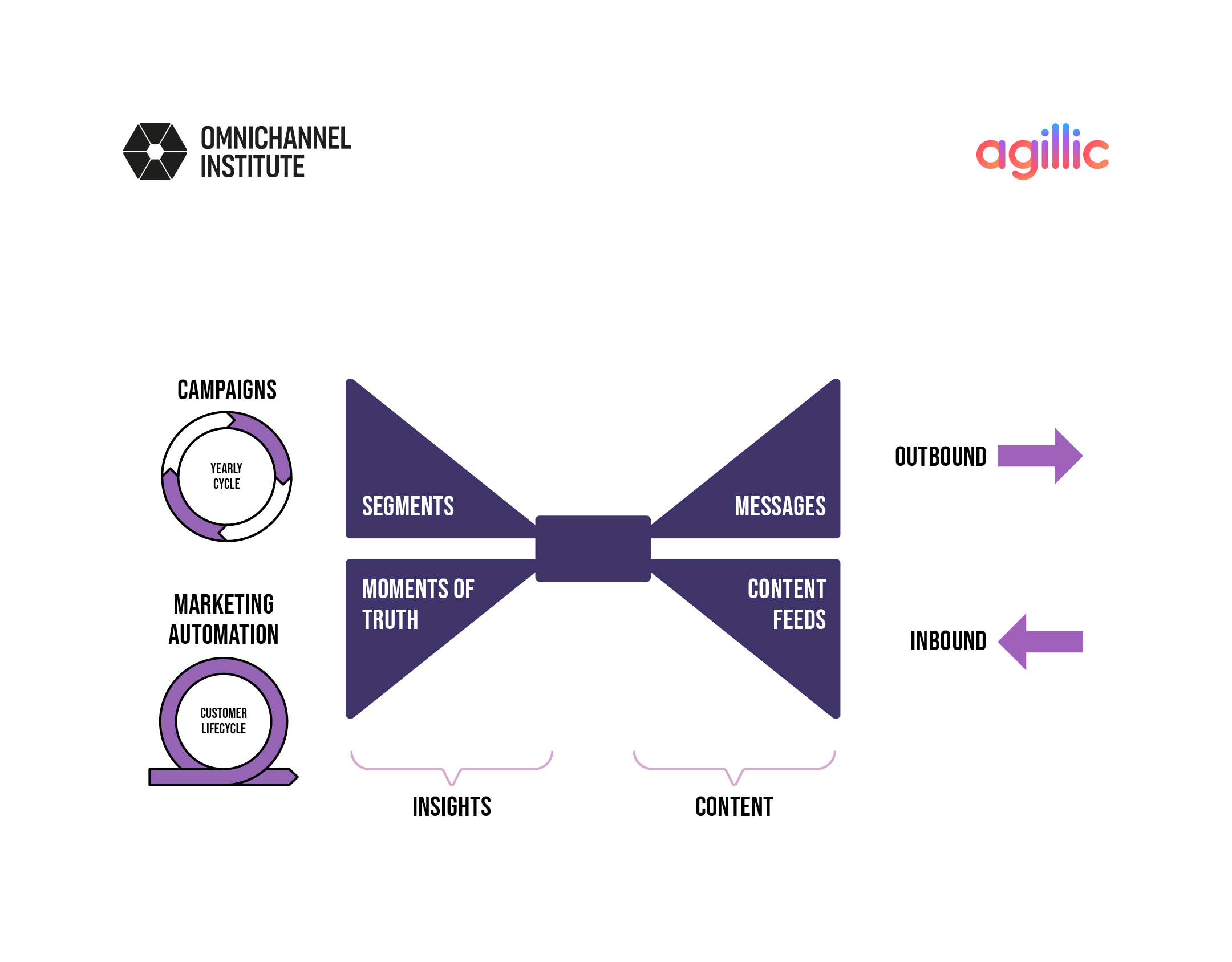
The Bowtie of Personalization
This podcast is based on the book 'Hello $FirstName' by authors Rasmus Houlind and Frans Riemersma.
Episodes will consist in turn of audio chapters from the book and subsequently discussions of the topic with experts and practitioners.
All models used in the book are available for download and free to use. Go to: www.omnichannelinstitute.com/resources?lang=en
A written abstract can be downloaded here: www.agillic.com/free-ebook-hello-firstname/