’Hello $FirstName’ - marketing experts discussing the topic of personalization
Ready to learn about personalization in marketing? Where first season was based on the book ’Hello $FirstName - Profiting from Personalization’ - Season 2 takes it further to explore the Content Crisis of Personalization - and the roles that the Content Layer (hint: a parallel to the Data Layer but with... well Content) and GenAI play in truly making personalization scale. The book is available in print and kindle and can be bought here: https://amzn.eu/d/7con9Ex (or your local .com, .co.uk, .se amazon...) A written abstract of the book can be downloaded here: https://agillic.com/free-ebook-hello-firstname/ All models and illustrations from the book can be downloaded here: https://www.omnichannelinstitute.com/resources?lang=en








Episodes

Jul 2, 2026
Jul 2, 2026
20 min
In Chapter 7 of Hello $Firstname, Jens Hård reads ‘Insights, Part 1: Segments’.
Jens Hård has around 20 years of experience in data-driven marketing and is CEO of Root Digital Group. In this chapter, he reads about the first insight corner of the Bowtie of Personalization: customer segments.
The chapter uses the Canadian bank Groupe Desjardins as its opening case and explores how segments can help an organization understand the different needs, desires, behaviours, and life situations of its customers. It explains how segments are built, how they can be turned into personas, and why demographic, behavioural, and value-based segmentation each serve different purposes.
The chapter also offers an important warning: segments help marketers get it less wrong, but they do not give perfect knowledge about individual people. That distinction matters when deciding whether to communicate explicitly or implicitly, especially when the topic is sensitive or the underlying data is probabilistic.
In his reflection at the end, Jens distils the chapter into a simple but powerful point: segmentation is not about categorizing people. It is about understanding what customers need at different moments in their lives and using that understanding to create more relevant experiences.
The chapter helps marketers see segmentation not as an outdated alternative to personalization, but as one of the core insight tools that makes better personalization possible.
More resources from the Hello $Firstname universe
You can buy the physical book here:https://amzn.eu/d/6jV4QZT
If the Amazon EU link does not work in your country, please search for Hello $Firstname: Profiting from Personalization, AI Edition on your local Amazon store.
You can download the illustrations and models from the book here:https://www.omnichannelinstitute.com/en/resources
You can also learn more about the Personalization Cards and Canvas, which help teams turn the Bowtie of Personalization into practical use cases, here:https://www.omnichannelinstitute.com/en/personalizationcards
Jul 2, 2026
Jul 2, 2026
31 min
In Chapter 6 of Hello $Firstname, Tom Peace reads ‘The Bowtie of Personalization’.
Tom Peace is CEO and founder of Sway Outcomes, a global customer strategy consultancy focused on loyalty and CRM. In this chapter, he introduces the central model of Part Two: the Bowtie of Personalization.
The chapter explains how meaningful personalization is created by combining two kinds of customer insight, segments and moments of truth, with two kinds of content, messages and content feeds. Through the Viva Gym case, the chapter shows how a fitness brand can use onboarding, inactivity signals, customer segments, message variants, and recommended classes to create a more relevant experience and reduce churn.
The chapter also makes an important point: true personalization magic happens before the channels. The marketer’s job is not simply to send an email, push notification, ad, or website banner. The job is to decide who should receive which message, in which moment, and with which supporting content, before adapting that experience to each channel.
In his reflection at the end, Tom connects the Bowtie to loyalty and CRM strategy. He highlights the importance of moments of truth in a congested marketplace, the growing need for first-party and zero-party data, and the opportunity to move beyond earn rules and reward value by creating emotional connection through relevant, timely, and personal communication.
The chapter opens Part Two by giving marketers a shared model for understanding what personalization really consists of.
More resources from the Hello $Firstname universe
You can buy the physical book here:https://amzn.eu/d/6jV4QZT
If the Amazon EU link does not work in your country, please search for Hello $Firstname: Profiting from Personalization, AI Edition on your local Amazon store.
You can download the illustrations and models from the book here:https://www.omnichannelinstitute.com/en/resources
You can also learn more about the Personalization Cards and Canvas, which help teams turn the Bowtie of Personalization into practical use cases, here:https://www.omnichannelinstitute.com/en/personalizationcards
May 18, 2026
May 18, 2026
13 min
In Chapter 5 of Hello $Firstname, Kim Jong Andersen reads ‘Marketing Without Personalisation’.
Kim Jong Andersen is Managing Partner at the Danish agency WDP. In this chapter, he reads a deliberately difficult exploration of what marketing would look like if we removed personalisation from the equation.
The answer helps clarify what personalisation can and cannot do. Personalisation is a powerful communication tactic, but it cannot compensate for a weak value proposition, boring creative work, poor reach, or a badly designed customer experience.
The chapter introduces the personalisation-value equation and explains how marketing value depends on proposition, format, reach, and personalisation. It discusses the balance between performance marketing and branding, the importance of creativity, the role of friction, and the danger of becoming so narrow with hyper-personalisation that reach disappears.
In his reflection at the end, Kim emphasises two important reminders from a brand-building perspective: the power of fame, and the danger of focusing only on customers who are already in-market. His point is that segmentation and personalisation matter, but they do not remove the need to build broader brand value and reach.
The chapter closes Part One by reminding marketers that personalisation creates extra value only when the fundamentals of marketing are already working.
More resources from the Hello $Firstname universe
You can buy the physical book here:https://amzn.eu/d/6jV4QZT
If the Amazon EU link does not work in your country, please search for Hello $Firstname: Profiting from Personalisation, AI Edition on your local Amazon store.
You can download the illustrations and models from the book here:https://www.omnichannelinstitute.com/en/resources
You can also learn more about the Personalisation Cards and Canvas, which help teams turn the Bowtie of Personalisation into practical use cases, here:https://www.omnichannelinstitute.com/en/personalizationcards
May 18, 2026
May 18, 2026
15 min
In Chapter 4 of Hello $Firstname, Dr Matt Johnson reads ‘Why Does Personalisation Work?’
Matt is the author of Blindsight and Branding That Means Business, and he hosts the blog neuroscienceof.com. In this chapter, he brings the listener into the psychology behind personalisation.
Why do people respond better to messages and content that feel relevant to them? The answer is connected to evolutionary psychology and the fundamental motives framework, including motives such as avoiding harm, avoiding disease, making friends, attaining status, acquiring a mate, and caring for family.
The chapter also tackles the darker side of personalisation: when it becomes creepy. It explains how personalisation can backfire when brands appear to stalk customers with repetitive ads, use data customers did not realise they had shared, or address topics that feel too sensitive or intimate.
Finally, the chapter explores the difference between being personalised and being personal, and why brands should be careful not to pretend they have a closer relationship with customers than they really do.
In his reflection at the end, Matt connects the chapter to the age of generative AI. His key point is that brands will not win merely by doing more personalisation, but by deciding how they personalise, and how well they express their unique brand personality in those personalised experiences.
More resources from the Hello $Firstname universe
You can buy the physical book here:https://amzn.eu/d/6jV4QZT
If the Amazon EU link does not work in your country, please search for Hello $Firstname: Profiting from Personalisation, AI Edition on your local Amazon store.
You can download the illustrations and models from the book here:https://www.omnichannelinstitute.com/en/resources
You can also learn more about the Personalisation Cards and Canvas, which help teams turn the Bowtie of Personalisation into practical use cases, here:https://www.omnichannelinstitute.com/en/personalizationcards
May 18, 2026
May 18, 2026
24 min
In Chapter 3 of Hello $Firstname, Mhari Coxon reads ‘Defining Personalisation’.
Mhari is a marketer from the United Kingdom, and in this chapter she takes the listener into one of the book’s central missions: creating a practical definition of personalisation that marketers can actually use.
The chapter distinguishes personalisation from customisation, actual personalisation from perceived personalisation, and explicit personalisation from implicit personalisation. It also explores the blurry boundary between segmentation, targeting, and personalisation, arguing that personalisation is not a simple either-or question, but a matter of degrees.
The chapter focuses specifically on personalised communication, meaning communication initiated by companies through marketing or communications teams. It builds towards a practitioner-friendly understanding that can unite different marketing disciplines and make personalisation easier to discuss, plan, and execute.
In her personal reflection at the end, Mhari expands on the idea of value creation. Drawing on her experience in B2B and B2B2C, she introduces the idea of a ‘triple win’: value for the company, value for the customer organisation, and value for the end user.
More resources from the Hello $Firstname universe
You can buy the physical book here:https://amzn.eu/d/6jV4QZT
If the Amazon EU link does not work in your country, please search for Hello $Firstname: Profiting from Personalisation, AI Edition on your local Amazon store.
You can download the illustrations and models from the book here:https://www.omnichannelinstitute.com/en/resources
You can also learn more about the Personalisation Cards and Canvas, which help teams turn the Bowtie of Personalisation into practical use cases, here:https://www.omnichannelinstitute.com/en/personalizationcards
May 18, 2026
May 18, 2026
16 min
In Chapter 2 of Hello $Firstname, Dr Jason Pallant reads ‘What Is the Problem with Personalisation?’
Jason is Director of the Marketing Technology Lab at RMIT University in Melbourne, Australia. He has also used some of the frameworks from Hello $Firstname in the marketing technology curriculum at RMIT.
This chapter explores why personalisation is such a difficult topic to align around. Marketers often use the same word while meaning very different things. UX and website teams may think about dynamic content and recommendations. Media and advertising teams may think about targeting and audiences. CRM and direct marketing teams may think about customer data, triggers, journeys, and owned channels.
The chapter also asks whether personalisation is worth the effort. It covers the operational complexity, the cost of technology and content production, the scepticism from parts of the branding community, and the risk of investing in personalisation without a shared definition.
In his reflection at the end, Jason highlights how different marketing backgrounds shape different interpretations of personalisation. He also points to the importance of shared definitions, especially if marketers want to build credible business cases, case studies, and use cases for personalisation.
The key point is that marketers need a clearer and more common understanding of personalisation before they can expect senior leaders to invest in it properly.
More resources from the Hello $Firstname universe
You can buy the physical book here:https://amzn.eu/d/6jV4QZT
If the Amazon EU link does not work in your country, please search for Hello $Firstname: Profiting from Personalisation, AI Edition on your local Amazon store.
You can download the illustrations and models from the book here:https://www.omnichannelinstitute.com/en/resources
You can also learn more about the Personalisation Cards and Canvas, which help teams turn the Bowtie of Personalisation into practical use cases, here:https://www.omnichannelinstitute.com/en/personalizationcards
May 18, 2026
May 18, 2026
10 min
In Chapter 1 of Hello $Firstname, Kim Motroen reads ‘The Hype of Personalisation’.
Kim is one of the founders of Publicis Foundry and has spent more than 20 years working with marketing, technology, and customer experience.
This chapter traces the roots of personalisation hype back to The One to One Future by Don Peppers and Martha Rogers, and explores why the idea of individualised communication has remained so powerful for marketers, brands, and technology vendors.
The chapter looks at the commercial promise of personalisation, from higher customer lifetime value to better omnichannel performance, while also questioning whether the technology has truly matured. It discusses martech growth, Gartner’s hype cycles, personalisation engines, multichannel marketing hubs, and the arrival of generative AI.
In his reflection at the end, Kim points out that even though we have moved from one-to-one marketing in the 1990s to AI and real-time personalisation today, many organisations still struggle with the fundamentals: data quality, ownership, execution, and actually getting things live.
The conclusion is clear: personalisation can create major value, but it is not magic, and it is not always plug-and-play. To avoid misunderstandings, bad investments, and broken promises, marketers need more clarity.
More resources from the Hello $Firstname universe
You can buy the physical book here:https://amzn.eu/d/6jV4QZT
If the Amazon EU link does not work in your country, please search for Hello $Firstname: Profiting from Personalisation, AI Edition on your local Amazon store.
You can download the illustrations and models from the book here:https://www.omnichannelinstitute.com/en/resources
You can also learn more about the Personalisation Cards and Canvas, which help teams turn the Bowtie of Personalisation into practical use cases, here:https://www.omnichannelinstitute.com/en/personalizationcards
May 18, 2026
May 18, 2026
19 min
Welcome to the audiobook edition of Hello $Firstname, the AI edition.
In this opening episode, Rasmus Houlind reads the introduction to the updated edition of the book and explains why personalisation has changed so dramatically since the first edition. Generative AI has made the content challenge easier to solve, but it has also made the need for clear frameworks, shared language, and practical execution even more urgent.
At the end of the introduction, Rasmus adds a short reflection on how agentic commerce, agentic personalisation, and agentic workflows are already changing how personalisation is perceived.
You will also hear the forewords read by Scott Brinker, longtime martech analyst and editor of the Chief Martec blog, and Rupali Jain, Chief Product Officer at Optimizely. Together, they frame the book from the perspectives of martech, AI, customer experience, data, content, and digital experience management.
This episode sets the stage for the full audiobook and introduces the core ambition of Hello $Firstname: to help marketers create more profitable, scalable, and meaningful personalised customer experiences.
More resources from the Hello $Firstname universe
You can buy the physical book here:https://amzn.eu/d/6jV4QZT
If the Amazon EU link does not work in your country, please search for 'Hello $Firstname: Profiting from Personalisation, AI Edition' on your local Amazon store.
You can download the illustrations and models from the book here:https://www.omnichannelinstitute.com/en/resources
You can also learn more about the Personalisation Cards and Canvas, which help teams turn the Bowtie of Personalisation into practical use cases, here:https://www.omnichannelinstitute.com/en/personalizationcards

May 13, 2026
May 13, 2026
56 min
What has actually changed in personalization now that generative AI is everywhere?
In this digital launch recording for the AI Edition of Hello $Firstname, Rasmus Houlind is joined by co-author Frans Riemersma and Maria Moreau from Boozt.
Together, they explore how AI affects personalization, why the Content Layer has become increasingly important, how the Bowtie of Personalization still helps marketers create shared language, and what Boozt’s practical CRM approach can teach us about making personalization work in the real world.
Consider watching the video-edition of this episode on youtube: https://youtu.be/_GgTJagrBT0?si=nUtoSsLMup6zaR6f
The conversation covers the Bowtie of Personalization, the CX Layers, the growing importance of the Content Layer, the difference between data and content as prerequisites for personalization, and Boozt’s practical approach to CRM and email personalization.
This is not just a conversation about AI hype. It is a discussion about what it takes to make personalization work in practice, across teams, channels, customer journeys, and commercial priorities.
In the episode, you will hear about:
• Why Hello $Firstname needed an AI Edition• What generative AI changes in personalization• Why the core logic of personalization has not changed• The Bowtie of Personalization• The CX Layers: Data Layer, Content Layer, and Personalization Layer• Why content has become a critical bottleneck• How AI changes the economics of content variation• Why more content does not automatically mean more relevance• Boozt’s approach to CRM and email personalization• How personalization becomes an operating discipline, not just a strategy slide• The Personalization Cards and how they help teams move from abstract ambition to concrete use cases
Resources:
The episode on youtube (including models and visuals)https://youtu.be/_GgTJagrBT0?si=nUtoSsLMup6zaR6f
Buy Hello $Firstname: Profiting from Personalization, AI Editionhttps://amzn.eu/d/6jV4QZT
Explore the Personalization Cardshttps://www.omnichannelinstitute.com/en/personalizationcards or
https://youtu.be/-sBQCySi180?si=LUzj_hRSmhd1r4Ns
Download the free abstract of Hello $Firstname, AI Editionhttps://bit.ly/HFNAI-ABS
Explore the Beyond Hello $Firstname: Personalization Practitioner coursehttps://omnichannelinstitute.learnworlds.com/course/personalization-practitioner
00:00 Welcome and intro01:34 Meet Rasmus Houlind01:48 Meet Frans Riemersma03:03 Meet Maria Moreau from Boozt05:13 Agenda for the session06:34 Why create a new AI Edition of Hello $Firstname?10:02 What has not changed in personalization11:40 The Bowtie of Personalization13:12 Which types of personalization are most affected by generative AI?15:32 Frans Riemersma on AI, martech, and the content challenge17:13 The content crisis in personalization18:35 The Data Layer explained19:48 The Content Layer explained21:35 The Personalization Layer explained24:49 Brand LLMs, canonical content, and AI-generated variants26:40 Using generative AI for campaign production27:42 People, skills, technology, and governance30:32 Maria Moreau introduces Boozt’s approach31:02 AI as a hot topic inside Boozt32:03 What is Boozt?34:23 Boozt’s Nordic department store strategy35:51 Why personalization is the heart of CRM37:18 Boozt’s email personalization results38:38 Three CRM jobs at Boozt40:17 Scaling email personalization across 1.2 billion emails41:59 Boozt’s email framework and prioritization logic57:14 Personalization Cards, Canvas, and course58:04 Final resources and closing
May 20, 2025
May 20, 2025
50 min
In this episode of Hello $Firstname, I’m joined by Nikolaj Skarbye from Scratcher.io for a deep dive into what might be the most overlooked shortcut to personalization: asking people directly - while making it fun.
At the heart of our conversation is zero-party data: the kind of willingly shared data that can include preferences, intentions, interests - even motivations. And instead of waiting for transactional behaviour to build up, gamification offers a way to collect this data early in the journey, at scale, and in ways that engage rather than interrupt.
The twist?If done well, gamification doesn’t just capture data - it builds emotional connection with the brand while it’s at it.
🔍 Highlights from the episode:
Beyond Spin-the-Wheel: From preference quizzes to product advisors and loyalty re-engagements, the real power of gamification lies in how it's designed, branded, and contextualized - not just the mechanics.
Short-cut to Smart Segmentation: You don’t have to wait for purchase data to personalize. Interactive experiences can surface intent and profile data long before a sale.
Data That Feeds the CX Layers: Zero-party data connects the Content Layer, Data Layer, and Personalization Layer - bridging marketing, CRM, and even call centre scripting.
Creative Use Cases: From Penguin knowledge tests for NGOs to Whopper giveaways at Burger King, and B2B IT assessments - Nikolaj shares cases that go well beyond e-commerce.
The Incentive Myth: Big prizes don’t always mean better participation. Smaller, brand-relevant rewards often lead to higher redemption rates and better lead quality.
From Collecting to Activating: We explore how zero-party data gets mapped, enriched, and activated across CDPs, ESPs, web personalization, and even in-store experiences.
📺 Watch the full video🎮 Check out Scratcher
📚 Want more?
This episode is part of Season 2 of Hello $Firstname, based on the book Hello $Firstname – Profiting from Personalization and the Content Crisis Manifesto.
📘 Buy the book 📄 Get the abstract 🎧 Listen to the audiobook 🖼️ Download the models & illustrations 🎤 Book Rasmus for a keynote or workshop
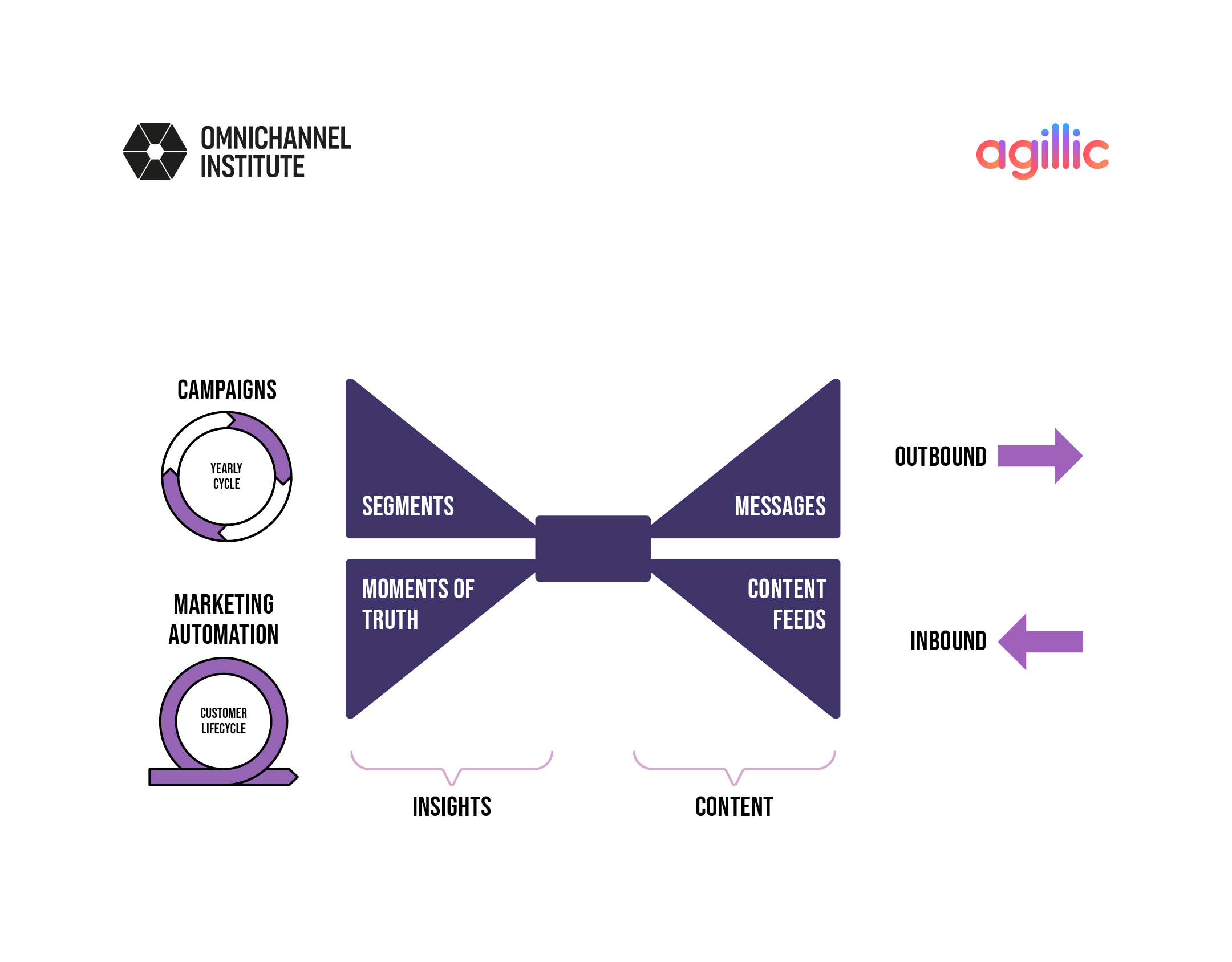
The Bowtie of Personalization
This podcast is based on the book 'Hello $FirstName' by authors Rasmus Houlind and Frans Riemersma.
Episodes will consist in turn of audio chapters from the book and subsequently discussions of the topic with experts and practitioners.
All models used in the book are available for download and free to use. Go to: www.omnichannelinstitute.com/resources?lang=en
A written abstract can be downloaded here: www.agillic.com/free-ebook-hello-firstname/