’Hello Me’ - AI has flipped Personalisation
Marketing to a new breed of consumer wielding the power of personalisation in their favour. Not yours.
For decades, personalisation has been something brands did to consumers. AI has flipped that. Instead of brands constantly telling consumers who to become, consumers now use AI to help them figure that out for themselves.
Hello Me is a podcast from Rasmus Houlind (Agillic, Hello $Firstname) and Frans Riemersma (MartechTribe, MartechMap.com) — an open, exploratory series about what happens to marketing once consumers start using AI to define who they want to be, instead of waiting for brands to tell them.
Each episode is a genuine conversation, not a product demo or a corporate interview: 45–60 minutes, recorded remotely, with guests invited to challenge the premise rather than just confirm it. There's no fixed season, no set release schedule, and no claim to having the answers — just better questions, one conversation at a time.
Got a sharp, unusual take on personalisation, AI, or the new rules of marketing — especially if you're not already in our usual orbit? We want to hear from you.
Watch the full video playlist on YouTube: https://www.youtube.com/playlist?list=PLJGgw-cJasRw
Hello Me — the concept for the show, and every question we're chasing this season: https://omnichannelinstitute.com/hello-me.html
Hello $Firstname — a free written abstract of the book this whole show builds on: https://agillic.com/free-ebook-hello-firstname/
Hello $Firstname — the audiobook edition, with a full cast of narrators, on Spotify: https://open.spotify.com/playlist/2zIvs5pSRNTO3YAeFUWZBL?si=zpeTEW_1RnWNHSwZZEAnWA
Personalisation Cards — workshop decks for Commerce, Subscription, Banking, and Charity/NGO teams: https://omnichannelinstitute.com/cards.html
MartechTribe — Frans Riemersma's research and consultancy on marketing technology: https://www.martechtribe.com
MartechMap.com — Frans Riemersma and Scott Brinker's joint map of the global martech landscape: https://martechmap.com
Omnichannel Institute — Rasmus's home for frameworks, books, and courses on personalisation: https://www.omnichannelinstitute.com








Episodes

Jul 23, 2026
Jul 23, 2026
10 min
In Chapter 15 of Hello $Firstname, Ida Söderbäck reads ‘The Basic Foundations for Personalisation’.
Ida Söderbäck is a customer loyalty and CRM marketing expert currently at the Swedish Red Cross. In this chapter, she reads the opening chapter of Part Three, where the book turns from what personalisation is and how it creates value to when personalisation is actually the right tactic to use.
The chapter asks three important questions: Do you have the prerequisites to do personalisation? Is it the right thing for your organisation to do? And is it the right thing to do now?
It argues that personalisation is a distinct communication tactic, not the answer to every marketing or business challenge. Before investing heavily in personalisation, organisations need a solid core offering, brand trust and demand, access to customer data and insights, and enough content to match those insights with something useful to say.
The chapter also makes a pragmatic point that is sometimes overlooked in personalisation projects: if the value proposition is weak, if the customer experience is fundamentally broken, or if no one knows or trusts your brand yet, personalisation is unlikely to fix the problem.
In her reflection at the end, Ida connects the chapter to loyalty and CRM. For her, personalisation is central to creating relevant communication, building relationships, and increasing loyalty and revenue. But she also underlines the chapter’s core message: personalisation becomes powerful only when the organisation has the right prerequisites, including individual-level data, the right competencies, and the martech systems to put it all into action.
The chapter serves as a useful reality check for any marketing leader facing pressure to personalise before the basics are in place.
More resources from the Hello $Firstname universe
You can buy the physical book here:https://amzn.eu/d/6jV4QZT
If the Amazon EU link does not work in your country, please search for Hello $Firstname: Profiting from Personalisation, AI Edition on your local Amazon store.
You can download the illustrations and models from the book here:https://www.omnichannelinstitute.com/en/resources
You can also learn more about the Personalisation Cards and Canvas, which help teams turn the Bowtie of Personalisation into practical use cases, here:https://www.omnichannelinstitute.com/en/personalizationcards
Jul 2, 2026
Jul 2, 2026
33 min
In Chapter 14 of Hello $Firstname, Rasmus Houlind reads ‘Tying It All Up in the Bowtie of Personalization’.
Rasmus Houlind is the author of Hello $Firstname and narrates this chapter himself because it brings Part Two together. The chapter revisits all four corners of the Bowtie of Personalization and shows how they come together across campaigns, marketing automation, and inbound platforms.
The chapter explains what good looks like from the customer’s point of view. A realistic personalized customer experience is not hyper-personalized at every touchpoint. It is a mix of highly personalized communication, semi-personalized communication, and generic communication, shaped by how much data the brand has and how engaged the customer is.
The chapter also goes deep into measurement. It discusses control groups, proxy metrics, statistical significance, customer lifetime value, net promoter score, and the importance of doing the math all the way to the money. It then gathers the maturity levels for campaigns, marketing automation, and inbound platforms into the front end of the Pyramid of Personalization.
In his reflection at the end, Rasmus adds a 2026 perspective. AI has made it easier to turn structured and unstructured data into insight, create message variants, localize content, generate images, tag content, and prepare content feeds for activation. But he also warns that more AI-generated content is not automatically better content. Marketers still need judgment, taste, governance, and a clear model for what they are trying to do.
The chapter closes Part Two with a clear conclusion: AI does not make the Bowtie obsolete. It makes the Bowtie more useful. The more powerful the technology becomes, the more important it is to understand the customer, the moment, the message, the content, and the value being created.
More resources from the Hello $Firstname universe
You can buy the physical book here:https://amzn.eu/d/6jV4QZT
If the Amazon EU link does not work in your country, please search for Hello $Firstname: Profiting from Personalization, AI Edition on your local Amazon store.
You can download the illustrations and models from the book here:https://www.omnichannelinstitute.com/en/resources
You can also learn more about the Personalization Cards and Canvas, which help teams turn the Bowtie of Personalization into practical use cases, here:https://www.omnichannelinstitute.com/en/personalizationcards
Jul 2, 2026
Jul 2, 2026
19 min
In Chapter 13 of Hello $Firstname, Mark Robertson reads ‘Personalization on Inbound Platforms’.
Mark Robertson is Partnerships Director at Mastercard Dynamic Yield and has spent around 25 years working across marketing, technology, sales, partnerships, and tools for both outbound and inbound marketing. In this chapter, he reads about personalization on websites, apps, and other inbound platforms.
The chapter explains that visitors arrive on inbound platforms with some kind of intention. If campaigns and marketing automation have done their job, the brand may even have helped spark that intention. The question then becomes how websites and apps can respond with the right content, functionality, messages, and feeds.
The chapter argues that the core customer experience must come before personalization. A website or app must first work well as a self-service experience. Only then should marketers add dynamic personalization, starting with ‘My’ pages, then content feeds, then personalized messages based on intent, and eventually the hiding of irrelevant content that creates unnecessary friction.
In his reflection at the end, Mark draws a clear distinction between testing, conversion rate optimization, and true personalization. He also points to the importance of operability across CDPs, loyalty systems, CMSs, digital asset management systems, ecommerce platforms, and analytics tools. His view is that AI will push inbound personalization beyond single-page testing towards more journey-based optimization.
The chapter reminds marketers that inbound personalization is not just about changing the homepage banner. It is about understanding customer intent in near real time and designing the whole platform experience around what the customer is trying to do.
More resources from the Hello $Firstname universe
You can buy the physical book here:https://amzn.eu/d/6jV4QZT
If the Amazon EU link does not work in your country, please search for Hello $Firstname: Profiting from Personalization, AI Edition on your local Amazon store.
You can download the illustrations and models from the book here:https://www.omnichannelinstitute.com/en/resources
You can also learn more about the Personalization Cards and Canvas, which help teams turn the Bowtie of Personalization into practical use cases, here:https://www.omnichannelinstitute.com/en/personalizationcards
Jul 2, 2026
Jul 2, 2026
34 min
In Chapter 12 of Hello $Firstname, Maria Moreau reads ‘Content, Part 2: Content Feeds’.
Maria Moreau is CRM Director at Boozt.com, where she works with CRM for millions of users. In this chapter, she reads about the second content corner of the Bowtie of Personalization: content feeds.
The chapter opens with HBO Max and the challenge of personalizing which movies, series, and episodes are shown to each user. It explains how content feeds differ from messages: they are often fed from existing sources such as product information systems, article databases, application databases, or ecommerce platforms rather than being written from scratch by marketers.
The chapter covers how content feeds can be grouped, sorted, ranked, filtered, and marked. It explains why the right feed can matter more than the ranking within it, how feeds can support both relevance and inspiration, and why marketers must be careful not to create narrow echo chambers when recommendation logic becomes too rigid.
Maria’s framing at the beginning makes the practical stakes clear: for teams managing CRM at scale, content feeds are vital to making personalization operational. They are what allow brands to activate large bodies of products, articles, offers, shows, events, or recommendations in ways that feel useful to each customer.
The chapter shows why personalization on inbound platforms is often less about writing a perfect message and more about choosing the right shelf, the right feed, and the right context.
More resources from the Hello $Firstname universe
You can buy the physical book here:https://amzn.eu/d/6jV4QZT
If the Amazon EU link does not work in your country, please search for Hello $Firstname: Profiting from Personalization, AI Edition on your local Amazon store.
You can download the illustrations and models from the book here:https://www.omnichannelinstitute.com/en/resources
You can also learn more about the Personalization Cards and Canvas, which help teams turn the Bowtie of Personalization into practical use cases, here:https://www.omnichannelinstitute.com/en/personalizationcards
Jul 2, 2026
Jul 2, 2026
33 min
In Chapter 11 of Hello $Firstname, Jordie van Rijn reads ‘Personalization in Marketing Automation’.
Jordie van Rijn is an email marketing and martech specialist who guides businesses in selecting marketing software through emailvendorselection.com. In this chapter, he reads about personalization in marketing automation and customer lifecycle communication.
The chapter explains why marketing automation is different from campaigns. Instead of deciding that it is Thursday and sending a newsletter, automation waits for customers to reach specific moments of truth and then responds with a relevant message. This makes timing one of the strongest drivers of perceived relevance.
The chapter explores value creation in marketing automation across increased top-line sales, churn reduction, and cost savings. It discusses abandoned baskets, onboarding flows, welcome programs, subscription upgrades, win-back tactics, next best action, next best experience, and the importance of measuring automation over a longer time horizon than campaigns.
In his reflection at the end, Jordi brings the chapter back to practical marketing work. He describes marketing automation as data set in motion and encourages listeners to find one additional valuable data point or trigger that could make an automation more relevant. His point is that creativity and data belong together.
The chapter reminds marketers not to let perfect become the enemy of good. A triggered message that exists and reaches the customer in the right moment will often create more value than a beautifully segmented message that never gets built.
More resources from the Hello $Firstname universe
You can buy the physical book here:https://amzn.eu/d/6jV4QZT
If the Amazon EU link does not work in your country, please search for Hello $Firstname: Profiting from Personalization, AI Edition on your local Amazon store.
You can download the illustrations and models from the book here:https://www.omnichannelinstitute.com/en/resources
You can also learn more about the Personalization Cards and Canvas, which help teams turn the Bowtie of Personalization into practical use cases, here:https://www.omnichannelinstitute.com/en/personalizationcards
Jul 2, 2026
Jul 2, 2026
25 min
In Chapter 10 of Hello $Firstname, Morten Suhr Hansen reads ‘Insights, Part 2: Moments of Truth’.
Morten Suhr Hansen is founder and senior partner at Subscrybe, where he works extensively with subscription businesses. In this chapter, he reads about the second insight corner of the Bowtie of Personalization: moments of truth.
The chapter opens with FT.com and a usage digest designed to reduce churn before subscription renewal. It explains how the timing of a message can make the difference between relevance and irrelevance, especially when customers are close to making a decision that affects their relationship with a brand.
The chapter defines a moment of truth as a moment in time where a customer or potential customer is, or should be, making up their mind about a decision that involves your company. It covers the difference between discovering intent and creating intent, how dynamic data can indicate a moment of truth, how absence of data can also be meaningful, and why marketers must be careful not to assume too much.
In his reflection at the end, Morten explains why this chapter is particularly important for subscription businesses. Moments of truth are central to retention, renewal, churn reduction, and long-term customer value, which is why they are also essential when working with the Personalization Cards in consulting and strategy work.
The chapter sets up the next discussion on marketing automation by showing why timing is often the most powerful personalization lever of all.
More resources from the Hello $Firstname universe
You can buy the physical book here:https://amzn.eu/d/6jV4QZT
If the Amazon EU link does not work in your country, please search for Hello $Firstname: Profiting from Personalization, AI Edition on your local Amazon store.
You can download the illustrations and models from the book here:https://www.omnichannelinstitute.com/en/resources
You can also learn more about the Personalization Cards and Canvas, which help teams turn the Bowtie of Personalization into practical use cases, here:https://www.omnichannelinstitute.com/en/personalizationcards
Jul 2, 2026
Jul 2, 2026
19 min
In Chapter 9 of Hello $Firstname, Peter Anders Franch reads ‘Personalization in Campaigns’.
Peter Anders Franch is Head of CRM, CLV, and Customer Insight at Matas in Denmark, where he works with Club Matas, one of Scandinavia’s largest loyalty programs. In this chapter, he reads about how personalization creates value in campaigns.
The chapter defines what a campaign is and distinguishes campaign communication from customer lifecycle communication. It explains how personalization in campaigns can increase sales, improve efficiency, reduce unnecessary media spend, avoid customer dissatisfaction, and even create new revenue streams through retail media.
The chapter ties together the upper part of the Bowtie of Personalization: segments and messages. It shows why customer segments matter so much when marketers decide which message variants to create, which audiences to target, which customers to exclude, and where paid media budget should be spent.
In his reflection at the end, Peter brings the chapter into the current AI moment. He argues that ecommerce, CRM, and personalization are changing fast, but that technology is only as good as the thinking behind it. AI can help brands reach relevance at greater scale, but judgment, empathy, and an understanding of what the customer actually needs still have to come from marketers.
The chapter is a practical reminder that personalized campaigns are not about doing more for the sake of doing more. They are about improving relevance, efficiency, and business value without becoming creepy, lazy, or wasteful.
More resources from the Hello $Firstname universe
You can buy the physical book here:https://amzn.eu/d/6jV4QZT
If the Amazon EU link does not work in your country, please search for Hello $Firstname: Profiting from Personalization, AI Edition on your local Amazon store.
You can download the illustrations and models from the book here:https://www.omnichannelinstitute.com/en/resources
You can also learn more about the Personalization Cards and Canvas, which help teams turn the Bowtie of Personalization into practical use cases, here:https://www.omnichannelinstitute.com/en/personalizationcards
Jul 2, 2026
Jul 2, 2026
36 min
In Chapter 8 of Hello $Firstname, Ana Mourão reads ‘Content, Part 1: Messages’.
Ana Mourão is a global martech and customer data leader, originally from Brazil and now based in the Miami area. In this chapter, she reads about the first content corner of the Bowtie of Personalization: messages.
The chapter opens with FC Copenhagen and its season pass renewal campaign. It shows how a brand can use customer segments, first-party data, paid media, owned media, and message variants to make outbound communication feel more relevant to different types of fans.
The chapter explains what a message is, how brand-led and customer-led messages differ, and why the same core message often needs to be adapted across channels, segments, cultures, and local markets. It also covers parametrization, personalized video, category entry points, customer value, and the danger of using personalization tricks without delivering actual relevance.
In her reflection at the end, Ana points to the practical power of the chapter: data, localization, the FC Copenhagen case, and the Personalization Cards as a resource for ideation, training, and turning a Bowtie strategy into something teams can actually use.
The chapter reminds marketers that outbound communication is an interruption. If you want people to stop what they are doing and pay attention, the message had better feel relevant.
More resources from the Hello $Firstname universe
You can buy the physical book here:https://amzn.eu/d/6jV4QZT
If the Amazon EU link does not work in your country, please search for Hello $Firstname: Profiting from Personalization, AI Edition on your local Amazon store.
You can download the illustrations and models from the book here:https://www.omnichannelinstitute.com/en/resources
You can also learn more about the Personalization Cards and Canvas, which help teams turn the Bowtie of Personalization into practical use cases, here:https://www.omnichannelinstitute.com/en/personalizationcards
Jul 2, 2026
Jul 2, 2026
20 min
In Chapter 7 of Hello $Firstname, Jens Hård reads ‘Insights, Part 1: Segments’.
Jens Hård has around 20 years of experience in data-driven marketing and is CEO of Root Digital Group. In this chapter, he reads about the first insight corner of the Bowtie of Personalization: customer segments.
The chapter uses the Canadian bank Groupe Desjardins as its opening case and explores how segments can help an organization understand the different needs, desires, behaviours, and life situations of its customers. It explains how segments are built, how they can be turned into personas, and why demographic, behavioural, and value-based segmentation each serve different purposes.
The chapter also offers an important warning: segments help marketers get it less wrong, but they do not give perfect knowledge about individual people. That distinction matters when deciding whether to communicate explicitly or implicitly, especially when the topic is sensitive or the underlying data is probabilistic.
In his reflection at the end, Jens distils the chapter into a simple but powerful point: segmentation is not about categorizing people. It is about understanding what customers need at different moments in their lives and using that understanding to create more relevant experiences.
The chapter helps marketers see segmentation not as an outdated alternative to personalization, but as one of the core insight tools that makes better personalization possible.
More resources from the Hello $Firstname universe
You can buy the physical book here:https://amzn.eu/d/6jV4QZT
If the Amazon EU link does not work in your country, please search for Hello $Firstname: Profiting from Personalization, AI Edition on your local Amazon store.
You can download the illustrations and models from the book here:https://www.omnichannelinstitute.com/en/resources
You can also learn more about the Personalization Cards and Canvas, which help teams turn the Bowtie of Personalization into practical use cases, here:https://www.omnichannelinstitute.com/en/personalizationcards
Jul 2, 2026
Jul 2, 2026
31 min
In Chapter 6 of Hello $Firstname, Tom Peace reads ‘The Bowtie of Personalization’.
Tom Peace is CEO and founder of Sway Outcomes, a global customer strategy consultancy focused on loyalty and CRM. In this chapter, he introduces the central model of Part Two: the Bowtie of Personalization.
The chapter explains how meaningful personalization is created by combining two kinds of customer insight, segments and moments of truth, with two kinds of content, messages and content feeds. Through the Viva Gym case, the chapter shows how a fitness brand can use onboarding, inactivity signals, customer segments, message variants, and recommended classes to create a more relevant experience and reduce churn.
The chapter also makes an important point: true personalization magic happens before the channels. The marketer’s job is not simply to send an email, push notification, ad, or website banner. The job is to decide who should receive which message, in which moment, and with which supporting content, before adapting that experience to each channel.
In his reflection at the end, Tom connects the Bowtie to loyalty and CRM strategy. He highlights the importance of moments of truth in a congested marketplace, the growing need for first-party and zero-party data, and the opportunity to move beyond earn rules and reward value by creating emotional connection through relevant, timely, and personal communication.
The chapter opens Part Two by giving marketers a shared model for understanding what personalization really consists of.
More resources from the Hello $Firstname universe
You can buy the physical book here:https://amzn.eu/d/6jV4QZT
If the Amazon EU link does not work in your country, please search for Hello $Firstname: Profiting from Personalization, AI Edition on your local Amazon store.
You can download the illustrations and models from the book here:https://www.omnichannelinstitute.com/en/resources
You can also learn more about the Personalization Cards and Canvas, which help teams turn the Bowtie of Personalization into practical use cases, here:https://www.omnichannelinstitute.com/en/personalizationcards
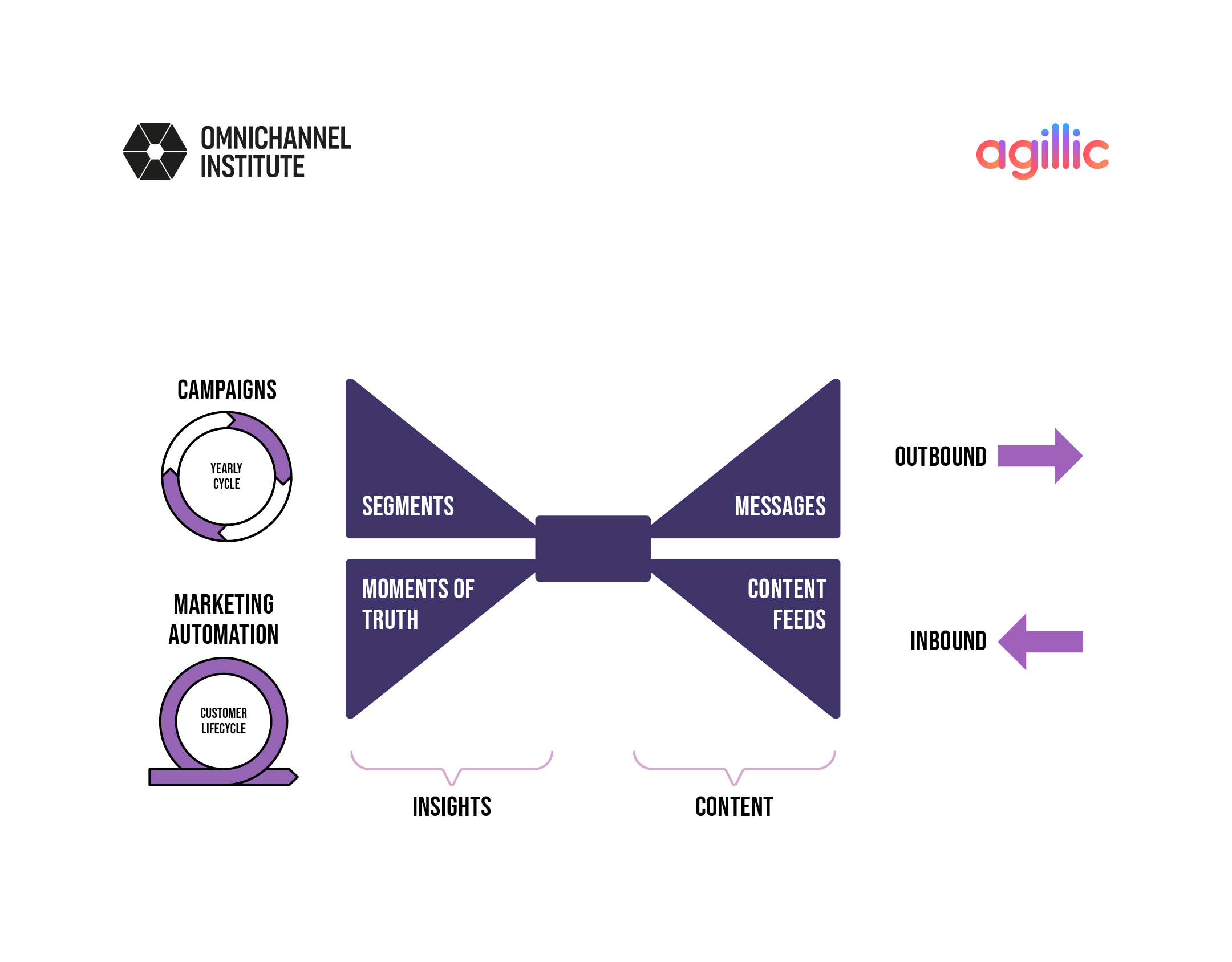
The Bowtie of Personalization
This podcast is based on the book 'Hello $FirstName' by authors Rasmus Houlind and Frans Riemersma.
Episodes will consist in turn of audio chapters from the book and subsequently discussions of the topic with experts and practitioners.
All models used in the book are available for download and free to use. Go to: www.omnichannelinstitute.com/resources?lang=en
A written abstract can be downloaded here: www.agillic.com/free-ebook-hello-firstname/